JVM Architecture
Follow the JVM's cooperating subsystems: class loading and verification, shared and per-thread memory, interpretation and JIT compilation, garbage collection, and native integration.
JVM components work together, not as a rigid pipeline
The JVM executes class-file instructions while maintaining the state necessary for objects, classes, methods, and threads. Its major responsibilities are loading and linking classes, checking bytecode, organizing runtime memory, executing code, reclaiming unreachable objects, and cooperating with the operating system.
The class-loading subsystem reads class definitions and makes them available to the runtime. Linking includes verification and preparation, with symbolic references resolved according to JVM rules. Initialization then runs class initialization logic when required. Loading a class is therefore not the same operation as calling its constructor to create an instance.
The bytecode verifier checks constraints such as valid instructions, type-compatible operations, and consistent operand-stack use. This helps preserve the managed execution model; it is not a general malware detector and does not make arbitrary native code safe.
Architecture diagrams group responsibilities. Real execution is interleaved: a running method may trigger another class load, an allocation may trigger collection, and a hot loop may be compiled while other threads continue executing.
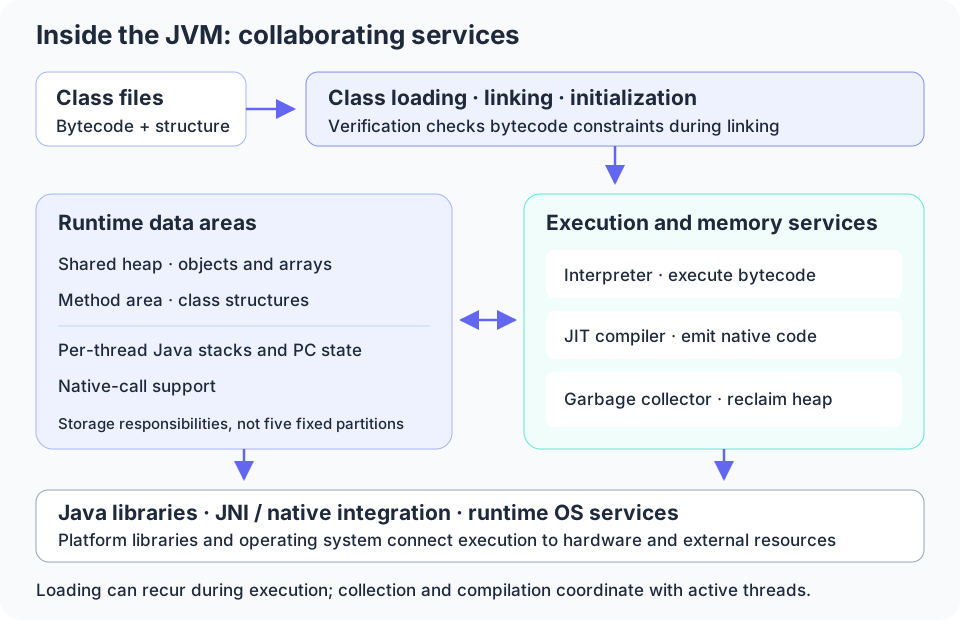
Runtime data areas hold different kinds of state
The shared heap holds objects and arrays; the logical method area holds per-class structures. Java stacks, program-counter state, and native-call support represent each thread's execution. Keeping these roles separate explains why an object can outlive the method that created it.
The JVM obtains memory from the operating system and organizes it into these areas. Sizes are not fixed by the architecture diagram: they depend on the JVM, application, limits, and growth policies. The full process footprint includes more than the Java heap.
| Area | Ownership | Main responsibility |
|---|---|---|
| Heap | Shared | Instances and arrays |
| Method area / HotSpot Metaspace | Shared | Class structure and runtime metadata |
| Java stack | Per thread | Active method frames |
| PC state | Per thread | Current JVM instruction in non-native execution |
| Native stack support | Per thread, implementation-dependent | Native call execution state |
Heap memory separates instances from references
For Student s = new Student(), the Student instance belongs to the heap model. If s is a method-local variable, its reference value belongs to that method's frame. Fields and array elements can also hold references, so references are not exclusively stack data.
The heap is shared among threads and managed by a collector. Reachability determines whether an object can be reclaimed; assigning one reference to null is insufficient if another live path still reaches the instance.
Stacks preserve each thread's call history
Every thread has a Java stack. Invoking a method creates a logical frame containing local-variable slots, an operand stack, and information needed for linking and return. The most recently invoked unfinished method is the active frame.
If main calls display, which calls calculate, normal returns remove calculate and then display before main continues. This last-in, first-out behavior frees frame state automatically, but it does not automatically free every heap object those frames once referenced.
Metaspace stores class blueprints, not all related objects
In modern HotSpot, native-memory Metaspace stores class metadata such as field descriptions, method structures, and runtime constant-pool information. Student's field names and method signatures are shared class information, while each Student instance has its own field values on the heap.
The JVM specification's method area is a logical concept; Metaspace is a particular implementation. Static field storage and string objects should not all be drawn inside Metaspace. In HotSpot, static values are associated with heap-resident java.lang.Class mirrors, and literal String objects are heap objects.
Two objects of the same loaded class share its definition. Different defining class loaders can load distinct classes with the same name, however, so 'one definition' must be understood per loaded class identity.
PC state identifies the current instruction
Each thread tracks its own execution position. During non-native execution, the JVM PC identifies the current bytecode instruction; branches and calls change which instruction executes next.
Independent PC state allows two threads to run the same method at different positions. The PC value is undefined for a native method under the JVM specification, and this logical state should not be confused with a permanently dedicated hardware register.
Native method execution needs native call state
A native method declaration refers to an implementation outside Java bytecode, commonly C or C++ machine code. Native call state supports arguments, local work, and returning control across the Java/native boundary.
A JVM may use conventional native stacks, and a concrete implementation can combine Java and native execution on one underlying thread stack. Treat the native stack as a responsibility, not a guarantee of an extra separately allocated stack for every thread.
class Camera {
    // Declaration only: a matching native implementation must be supplied.
    native void openCamera();
}Execution engine: interpretation and native compilation
The execution engine implements the behavior of bytecode instructions. An interpreter can begin executing without first optimizing an entire application; a just-in-time compiler turns selected bytecode into machine code suitable for the current CPU.
Garbage collection is often grouped with the execution engine in teaching diagrams because allocation, roots, and safe execution are closely coordinated. Its specific job is memory reclamation, not translating bytecode into instructions. An architecture drawing should not imply that GC runs after every method.
JNI is a bridge to native code
The Java Native Interface defines how native code can interact with a JVM: native functions can be called from Java, and native code can access Java objects, invoke methods, and handle JVM exceptions through the interface.
Typical uses include reusing an existing C library, integrating specialized hardware, or calling platform-specific facilities. Native integration also adds deployment and correctness risks: ABI compatibility, architecture-specific binaries, reference lifetimes, and native resource cleanup must be handled explicitly.
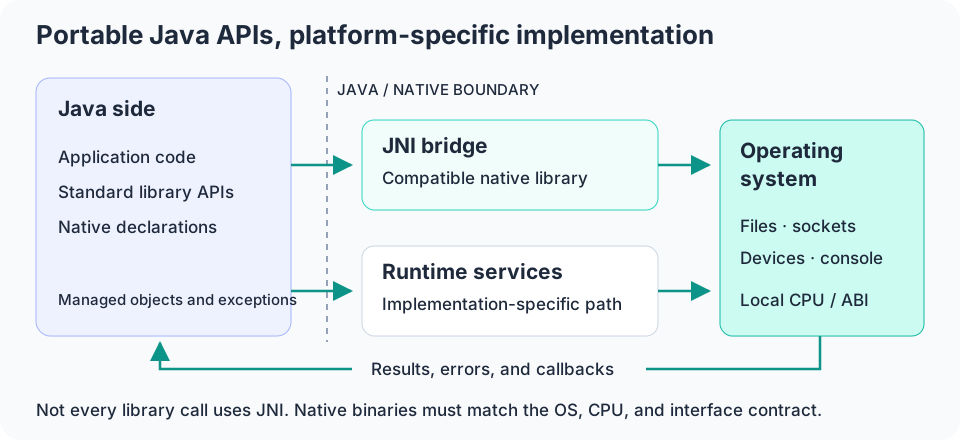
Native libraries bind a portable API to a platform
Native libraries contain platform-specific machine code. Common filenames use .dll on Windows, .so on Linux, and .dylib on macOS. The binary must also match the processor architecture and the runtime's native interface requirements; matching a filename extension is not enough.
Files, networking, thread creation, time, graphics, and console output eventually need operating-system facilities. Java exposes stable library APIs while the runtime adapts their implementation to each platform. System.out.println is a useful example of this abstraction, but its exact implementation path is not a universal fixed JNI pipeline.
| Platform | Common shared-library format | Portability check |
|---|---|---|
| Windows | .dll | Windows ABI and CPU architecture |
| Linux | .so | Linux ABI, dependencies, and CPU architecture |
| macOS | .dylib | macOS ABI and supported CPU architecture |
Execution is adaptive, not a single translation pass
The same method can begin interpreted and later execute as compiled code. Runtime observations help the JVM decide where compilation is worth its cost, so startup behavior and steady-state performance can differ.
Compilation consumes CPU and memory, and optimized code may depend on assumptions about observed types or control flow. If an assumption stops being valid, the runtime can deoptimize and resume a less specialized execution form.
Interpreter and JIT divide the work
An interpreter executes bytecode through runtime instruction handlers. It can start promptly, but repeated execution of hot code can incur more overhead than executing optimized machine code.
A JIT compiler spends compilation effort on frequently used methods or loops and retains the resulting native instructions for reuse. This is the source's central performance distinction: avoid repeatedly interpreting the same hot work, without requiring ahead-of-time native compilation of every class.
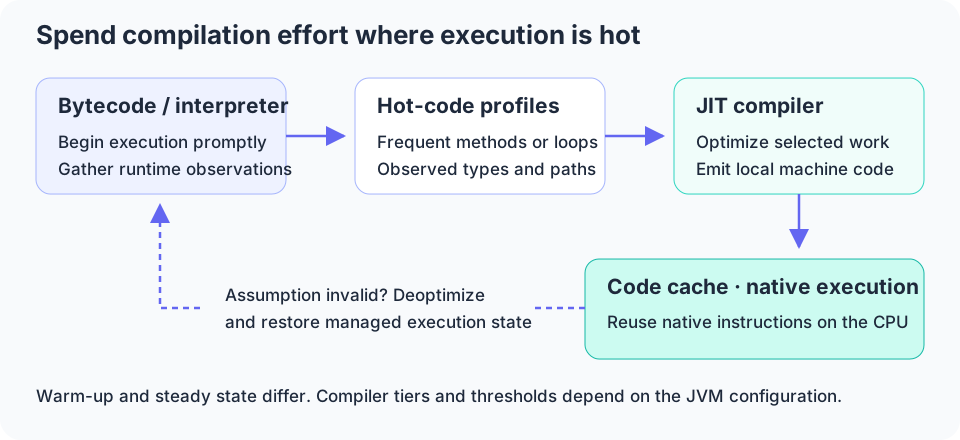
Compilation tiers and the code cache
HotSpot can use tiered compilation to balance quick compilation with more expensive optimization. Exact tiers, thresholds, and compiler availability depend on the JVM build and configuration; they are implementation details rather than requirements for all JVMs.
Compiled instructions occupy a code cache, distinct from heap objects and class metadata. A larger -Xmx does not automatically enlarge this region, which is another reason to view process memory as several cooperating budgets.
Optimizations must preserve Java behavior
Inlining can remove call overhead and expose more optimization opportunities. Escape analysis may show that an allocation does not need to materialize as an ordinary heap object, allowing scalar replacement in suitable cases.
These are runtime opportunities, not source-level promises. Do not infer physical layout or performance solely from a new expression; measure the workload after warm-up and keep the language's observable behavior as the correctness boundary.
Memory regions are not the Java Memory Model
The heap/stack/Metaspace map describes runtime storage responsibilities. The Java Memory Model instead describes which reads and writes may be observed across threads and what ordering guarantees synchronization establishes.
A shared heap does not imply immediate visibility of every ordinary field update. A private local reference does not make the object it reaches private. Correct cross-thread access requires appropriate publication and synchronization.
Visibility and locking are separate from allocation
synchronized provides mutual exclusion and ordering guarantees through monitor operations. volatile provides visibility and ordering for accesses to that variable, but does not make a compound operation such as count++ atomic.
final has special initialization guarantees when objects are constructed and published correctly. None of these modifiers changes the basic distinction between a reference value, its target object, and the metadata describing the object's class.
Class loading and object creation have different lifetimes
Loading a class supplies a reusable definition. A new expression allocates and initializes an instance using that definition; constructors establish instance state, rather than loading a fresh copy of all method definitions for every object.
Objects can survive their creating method if another reachable reference retains them. Conversely, an unreachable object can be reclaimed even while the class that describes it remains loaded.
An instance contains state, not a copy of every method
A conceptual Student instance contains its id and name reference, along with runtime bookkeeping. Field descriptions and method definitions belong to class-level structures shared by instances of that loaded class.
Exact object headers, reference widths, padding, and alignment are implementation- and configuration-dependent. The source's blueprint analogy explains sharing; it is not an exact byte-offset layout for every Java release.
GC reclaims unreachable objects, not merely unused variables
When no live path from the collector's roots reaches an object, it becomes eligible for reclamation. Setting s to null removes one path; aliases, collections, static references, or native references may still keep the object alive.
Collection timing is controlled by the runtime. GC reduces manual memory-reclamation errors, but it does not eliminate leaks caused by unwanted reachable objects, and it does not replace explicit management of external resources.
Roots establish liveness; generations exploit lifetime patterns
Active execution references and other runtime roots provide starting points for tracing live objects. A cycle of objects with no reachable path from a root can still be garbage; reference counting is not the general Java reachability rule.
Many collectors exploit the observation that most objects die young. They collect younger objects frequently and treat long-lived objects differently. Eden and alternating survivor spaces are a useful teaching model, not a mandatory physical layout for all collectors.
Collector choice changes mechanics, not the language model
Collectors make different throughput, pause-time, CPU, and memory trade-offs. Some use contiguous generations; others use regions and concurrent relocation. The source's heap picture should therefore be read as a conceptual example.
Collector selection and defaults vary by release, JVM, and platform. Start with workload requirements and measured behavior rather than assuming one collector is always fastest or that every collector exposes the same spaces.
Reclamation can include moving live objects
A collector can copy or compact live objects to consolidate free space. It must keep references valid when it moves objects, coordinating with application execution through implementation-specific mechanisms.
This is why Java code works with managed references rather than performing arithmetic on object addresses. The deep-dive lesson illustrates fragmentation and compaction without assuming a particular collector's full algorithm.
The process is larger than its heap
The JVM requests memory from the operating system for heap, metadata, stacks, compiled code, and runtime support. Direct buffers and native libraries can add allocations outside ordinary heap accounting.
-Xms and -Xmx control heap sizing; -Xss affects thread stack sizing. These flags do not create a single process-wide ceiling. Leave headroom under operating-system or container limits for the rest of the runtime.
Threads share data but retain independent execution
Two threads can share Student class metadata and a Student instance while maintaining separate call stacks and instruction positions. Each stack records that thread's outstanding invocations.
Thread implementation and scheduling vary by runtime and thread kind. Avoid turning the logical per-thread model into a claim that every Java thread always owns a dedicated operating-system thread or identical native stack allocation.
Synchronization coordinates access to shared objects
Stack separation prevents one method invocation from accidentally becoming another thread's local frame; it does not coordinate accesses to a shared heap object. Locks and other concurrency mechanisms provide that coordination.
Monitor implementation details can change across JDKs and execution states. At the architecture level, keep the contract—mutual exclusion and ordering—separate from any specific object-header encoding.
Bytecode uses local slots and an operand stack
A method's bytecode loads values from local-variable slots onto an operand stack, performs operations, and stores or returns results. This logical stack-machine model is separate from how an optimizing compiler eventually uses physical CPU registers.
Class files also carry symbolic references and structure information. Loading and verification prepare those structures for execution; the class file is not merely a platform-specific native executable with a different suffix.
Reflection exposes loaded class structure
Reflection allows programs to inspect classes, fields, constructors, and methods through Java APIs. This capability depends on the runtime retaining structural class information rather than keeping only anonymous machine instructions.
Reflective access still follows runtime access rules and module boundaries. The existence of metadata does not grant unrestricted access to every private or encapsulated member.
Compile-time generation is not runtime class execution
Annotation processing belongs to the build side of the platform: processors can inspect source-level declarations and generate additional source or resources during compilation. It is not the JVM interpreter evaluating annotations on every method call.
Annotations retained at runtime may be inspected by frameworks through metadata APIs. Distinguishing those two stages prevents confusion between what the JDK does while building and what the runtime does while executing.
Native integration adds a second resource boundary
JNI native code can hold references that keep Java objects alive, and it can allocate memory that the Java heap collector does not reclaim directly. Correct lifetime management must cover both sides of the boundary.
An application can therefore have a modest Java heap and still exhaust process memory through native allocations or excessive thread-related overhead. Treat native integration as a systems boundary with explicit ownership, not just a performance shortcut.
Tune the constrained subsystem
Slow startup, sustained allocation pressure, long collection pauses, and high native-memory usage are different problems. Identify which subsystem is limiting the application before changing compiler, collector, or size settings.
Measure a representative workload and account for warm-up. Enlarging the heap cannot fix every stack overflow, class-loader retention problem, blocked native call, or inefficient algorithm.
Choose evidence that matches the architecture
A thread dump helps explain active calls and blocking; a heap dump helps explain retained objects; class-loading and native-memory observations help distinguish metadata or non-heap growth. JDK tools such as jcmd expose different views depending on the release and target JVM.
Use the symptom to choose the evidence. Capturing a large dump can have operational costs, so collect diagnostics with appropriate permissions and an awareness of production impact.
Failure location narrows the investigation
StackOverflowError points toward excessive call depth or stack requirements. Java heap space exhaustion points toward heap capacity and retention. Metaspace pressure points toward loaded classes, class-loader lifetimes, and native metadata capacity.
A process can also be terminated by the operating system or container without the JVM successfully reporting an OutOfMemoryError. Preserve the exact error, logs, and resource limits rather than labeling every failure a heap leak.
Architecture reasoning checks
Explain Student s = new Student() using three distinct ideas: a loaded class definition, a heap instance, and a local reference in the current frame. Then explain how that instance can survive after the method returns.
Explain why the same class file can execute on different operating systems even though the runtime contains platform-specific machine code. Finally, explain why increasing -Xmx does not solve every process memory failure.
- Can two threads share an object while holding references in separate frames? Yes; frame privacy does not imply object confinement.
- Does nulling one variable force GC? No; reachability and collector scheduling determine reclamation.
- Does every Java method call use JNI? No; JNI is a native integration interface, not the universal bytecode execution path.
- Is Metaspace the JVM specification's only valid method-area design? No; it is a HotSpot implementation mechanism.